

Yue’s Coaching Corner
My course, AI-Powered Executive Presence, Communication, & Influence, is a part of the end-of-year Maven FasTrack sale. Get 30% off through Sunday. Get in for the last cohort of the year!
Want to build more influence and accelerate your path to leadership? Consider working with me in 1:1 executive coaching for 6 months Schedule a free intro call here.
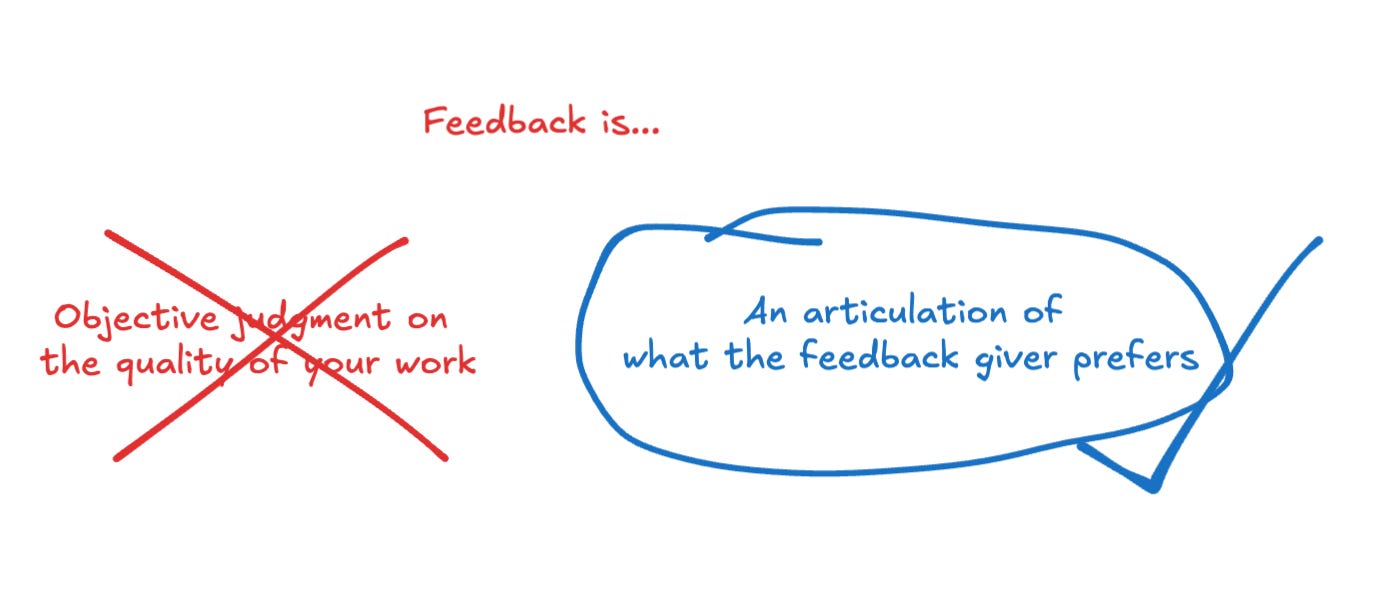
The education system teaches us to associate feedback (grades) with right or wrong. If you received a low grade, it is because someone with authority (the teacher) indicated that your work was wrong or not good. As students, our job was to improve our answers until they were deemed objectively good or correct. We take this concept of feedback to the workplace. When we receive critical feedback from someone with authority (our managers), we work hard to correct it.
The problem with this approach is that it assumes 1) there is an objective right or wrong and 2) those with authority are the arbiters of what is right or wrong. While this may have been true in math class, it is far from the truth in the workplace. In any workplace, risks, trade-offs, and grey areas exist. One person’s perspective is rarely the only one that matters. The more senior the roles, the more the opinions of multiple directors or VPs matter in a decision or promotion case.
An Alternative Approach to Feedback
Another way to look at feedback is that it tells you what the feedback-giver prefers in a given situation. It is about them, not you. It is a reflection of their preferences or what they think should happen. It is not a reflection of your capabilities, intelligence, or self-worth.
Let’s take an example where a peer tells you that you need to collaborate more with their team. What this feedback tells you isn’t that you aren’t being collaborative with their team. It tells you that your peer prefers you to collaborate more. It is a subjective preference.
In another example, let’s say your mentor tells you that you need to speak up more in meetings. What it says is that your mentor believes you have important comments to make and that speaking up is valuable for your career growth. It does not say you are not good at speaking up or that your current inputs are not good.
This skill of evaluating feedback subjectively is one of my theories on why arts and humanities majors do really well in leadership. When you create an artwork, if the teacher says it’s not good, it doesn’t mean it is a bad piece of art. Perhaps it’s simply that the teacher doesn’t like it. (h/t Diana Kimball Berlin Hilary Gridley).
3 Steps To Actioning on Feedback
This lens of feedback gives you the agency to decide what to do with it. Here are three steps to judge the value of the feedback for yourself, and decide what to do:
Reflect on what the feedback tells you about the giver of the feedback. What does she think is true about the world? What preferences does this show she has? Why might she feel this way?
Remind yourself of your values and priorities. What is it that you want to accomplish? What type of person do you aspire to be? Who is your target audience or customer for your work?
Decide whether this feedback is worth taking action. Does it come from someone you trust who has your best interests in mind? Do you agree with how he sees the world? Is it someone you want to become more like? Is it an audience you want to serve more?
These steps create a valuable filter for feedback so that you’re not blindly trying to incorporate all of it, or valuing all incoming feedback the same way. You may decide to take action on the feedback because the person delivering it is the type of leader you want to be. Or, you may decide to ignore it because you think the other party had bad intentions. You may make a change in the product because the feedback is from the type of customer you want to sell to. Or you might discard it because it is not from your target audience.
When you view the feedback as the other person’s expressed preferences, rather than a judgment on yourself, you take back the agency to decide next steps from a centered, calm place.
That’s all folks! See you next week at 3:14 pm.
Yue
A check I use before acting on feedback is to ask for one recent, specific example. If the person can name the moment, it is usually information about a real pattern. If they cannot, I hold it lightly and watch for a second source before changing anything. It keeps the sting from deciding what I do next.
This has really got me thinking about how early we learn to treat feedback as a verdict on who we are! Especially when it comes from someone in authority. I spent years taking comments about needing to try harder as proof that I wasn't doing enough, rather than questioning whether the expectations or the way I was being taught actually worked for me. And goodness, that habit doesn't magically disappear when you leave school! I really like the idea of teaching people to be curious about feedback rather than automatically accepting it as fact. Although I suspect unlearning that habit might take a fair bit of practice!