

Client: I’m currently a Staff-Level Individual Contributor. My next step would be a Director-level role managing a few teams. With AI, I hear so much about how experienced ICs are in very high demand. And switching into people management is quite a hurdle in my current situation. Is it worth it to try to make the switch?
Why Did We Need Middle Management?
Before AI, to get into executive leadership, landing a team management role was mandatory. It was not enough to show that you can build and ship impactful work on your own. It was also critical to demonstrate the ability to lead and work through others. Why? One person can only accomplish so much on their own. Building billion-dollar companies requires teams to work closely together.
As a result, influential leaders spiked in bringing people together behind a bold vision. The top 1% leaders were among the best at bringing people together and resolving conflict. With AI, the bottleneck is moving from execution coordination to creativity and distribution, and changing the type of people-work to be done.
10X Efficiency with AI
With the rise of AI, the constraint of a person’s capacity is greatly loosened. Increasingly, very small teams are doing work that previously required hundreds of people. Pre-AI, the standard team size to hit $100M ARR was 1000 employees. Salesforce had 700 employees and took 5 years. Cursor hit $100M ARR with a team of 20 people in 12 months. Lovable took 45 people about 8 months. As a whole, the new breed of AI-native SaaS companies runs at 7-10X the efficiency of pre-AI SaaS companies.
This incredible step-change in efficiency is achieved through the use of AI agents and AI-first operations. In the AI-first world, humans are no longer executing on task at a time for 40 hours a week. Instead, they are directing, orchestrating, and reviewing multiple AI agents running in parallel around the clock. For example, engineers at OpenAI manage 10-20 threads (source) to support their work. The AI agents run in their own cloud sandboxes, documenting new code, writing new test cases, cleaning up feature flags, and resolving dependencies. 100% of the code at OpenAI for 95% of engineers is code reviewed and maintained by Codex.
This means that ambitious builders no longer need to manage people to deliver outsized impact. Sam Altman talked about the billion-dollar startup with a team of 1 (Forbes), with some putting the time estimate as early as 2028. People leaders will manager larger scope than ever before. The result? More smaller teams, more senior people leaders. The “middle-management” layers will be drastically reduced. Eleven Labs, for example, runs 20 micro-teams of 5 to 10 people, delivering $200M+ ARR.
I believe that the workplace structure will recalibrate to this new reality over the next few years. Increasingly, senior experienced individual contributors will manage teams with the scope of the current Directors. Directors and VPs will either be pushed out or switch to senior IC roles. The executives who adopt AI-first mentalities and skillsets will run ever-larger scopes of work. And those who don’t will get replaced.
Prepping for the Future of Middle Management
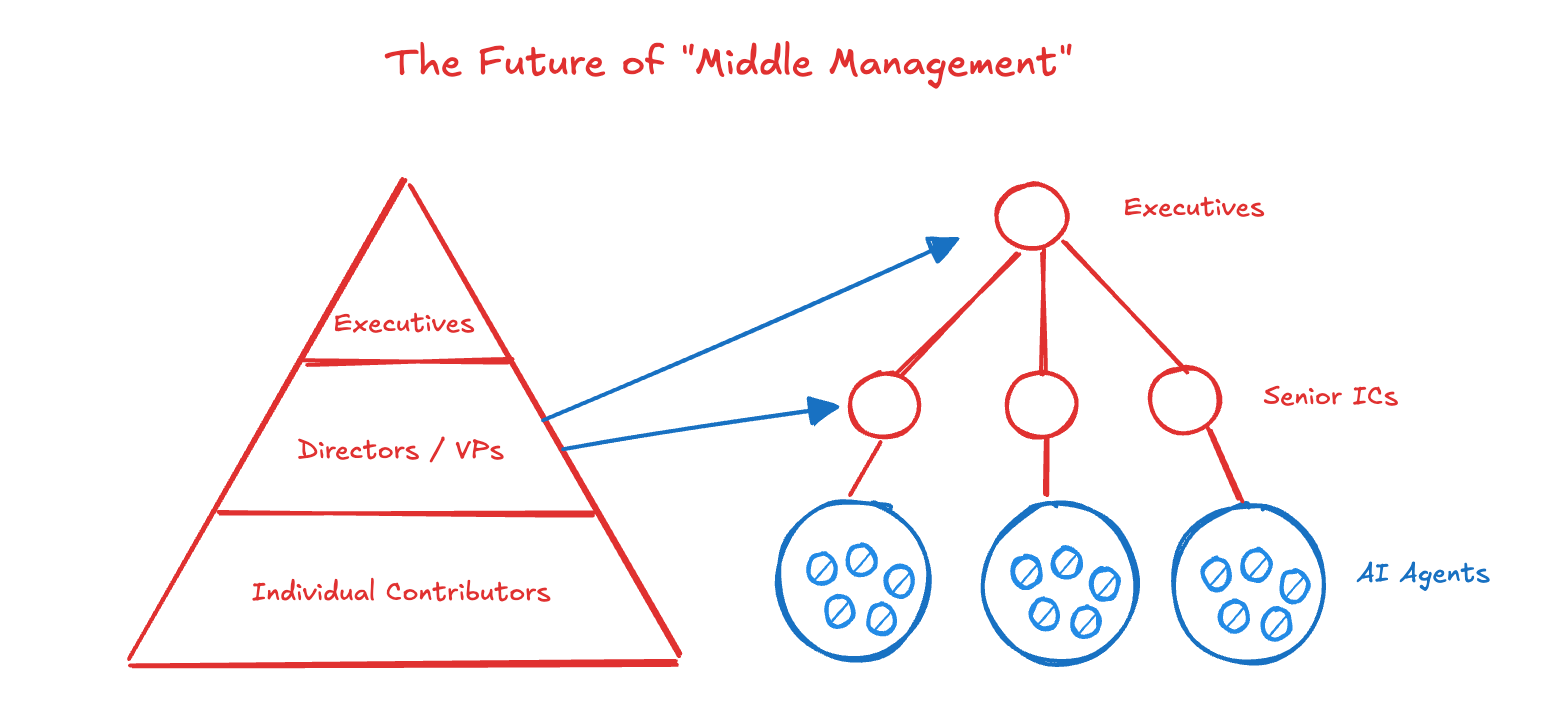
Going back to the original question, I would encourage those looking to advance their careers to hone their AI skillset and develop company-level strategic mindsets:
Build AI agents to support your daily work: if you have a repetitive task, build an AI agent to do or start it for you.
Understand business strategy: think and strategize at the company and business level, not at the feature or part of a business level.
Dream big: Don’t wait for permission to dream big and broad, and make your ideas known to your skip-level or skip-skip-level leaders.
I believe the “worst case” here is to sit and wait. If you’re one to two years away from a “middle-management” role, it’s time to pick a side. Either grow your seniority and impact as an AI-first Senior individual contributor, or try to make the hop to the top of a function. It’ll be increasingly difficult to find and land middle management roles as companies orient towards highly empowered microteams.
That’s all folks! See you next week at 3:14 pm.
Yue
Yue’s Coaching Corner

My free talk on How To Prep for High Stakes Leadership Meetings with AI has 1000+ attendees! Join us next Monday live or get the recording. Sign up here.
On the note of executive leadership, my next cohort on Master Executive Presence & Communication with AI is now enrolling for a March 9th start. Get 20% off as a paid subscriber to this newsletter!
Agree and disagree.
Yes, the need for middle management will shrink. But that doesn’t mean senior ICs automatically become managers. Management is a different craft.
If AI creates 10x efficiency, it also creates 10x accountability. Not every engineer wants, or is ready for, that level of ownership.
From what I’m seeing, AI amplifies the great, but not everyone.
Two groups are most at risk:
- Average engineers. Who rely on specifications in assigned tickets. They will be replaced.
- Layered middle management. Leaner organizations means less layers. No other way around it.
And two groups will shine:
- Great engineers. Less people can do more.
- Capable frontline managers. Bigger scopes require strong managers.
AI rewards capability, technical or managerial, and exposes mediocrity in both.
Super insightful! Thank you for sharing! As a new EM, what do you mean by
"... Either grow your seniority and impact as an AI-first Senior individual contributor, or try to make the hop to the top of a function." ?