

Many companies are focused on productivity improvements from AI. Sales teams are using it to accelerate list building and email generation. Marketing teams are using it to create high-quality media. Product teams are using it to prototype and build software. Customer support teams are using it to triage inbound tickets and auto-respond to an increasing percentage of questions. All of this increases productivity, sometimes by 5X to 10X. However, as adoption matures, the gains from using AI to accelerate specific tasks will normalize across companies.
The challenge with only focusing on productivity gains is that while each function becomes more efficient within its own boundaries, the boundaries remain. A new learning from a sales call does not naturally affect marketing and product prioritization. A win in paid marketing does not change how sales prioritizes leads. The coordination and context transfer between marketing, sales, product, and customer success remains manual. There is time spent reconciling data between systems, reinterpreting insights across functions, and re-explaining context in recurring meetings. As teams grow, this drag compounds nonlinearly.
Context built into the system
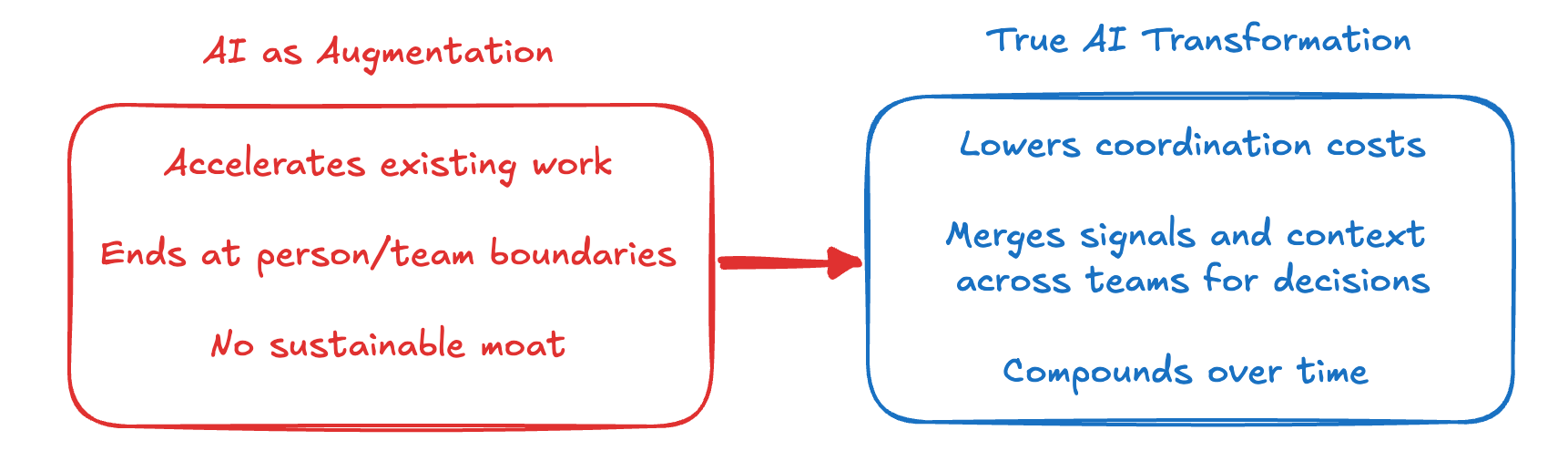
Sustainable competitive advantage will come from reducing and eliminating coordination costs across functions and teams. This requires fundamental structural changes to how information is gathered and stored, and then pushed out into the organization. Leaders must evolve their data infrastructure, tooling, and processes such that context is embedded in the system and pushed to the AI agents and teams when relevant. When context is at the fingertips of the user, and not hidden in the minds of select individuals, coordination cost decreases and acceleration compounds.
In the pre-AI days, teams that embedded context into their documentation moved faster than those who struggled to propagate context. Engineers who comment the logic and dependencies of the code in line. PMs who kept a running list of decisions made at the top of their requirements documents. Project managers who kept versions of project plans in the same spreadsheet for historical context. Sales teams that auto-updated a Slack channel with every new deal and comments from the rep who closed it. All of these are mechanisms where context lived with the artifact, and was easy discoverable and spread across organizational lines and across time. This accelerated decisions and reduced coordination cost.
AI unlocks an entirely new set of possibilities to continously refine and recalibrate across teams. The learnings from one sales call could immediately be translated into a shift in a paid marketing campaign and a new prototype for a product feature. A customer support complaint can automatically trigger a bug fix in the code. Sales strategies can get updated regularly based on live trends hitting a certain threshold of volume, rather than follow a quarterly process.
Enabling these trigger-based actions with AI rather than time-based actions (e.g. quarterly planning cycles, weekly team meetings), starts with ensuring context and information is trascribed, extracted, and stored as much as possible. Transforming the organization’s data flow and infrastructure is the priority. For every day you do not store sales calls and product decisions, you lose a day of advantage to your AI-native competitor startup.
Feed your webinar transcripts, product documentation, CRM notes, meeting transcripts, behavioral engagement data, social signals, and win-loss data from paid campaigns into well structured AI accessible repositories. If it requires collaboration, avoid being the owner of orphaned documents and conversations. Leaders should no longer be worrying about valuable context leaving with departures or “only one person knows how this works.” Write it down.
Then, build on top of these continuously updating repositories AI agents and automations. Teach AI to continously learn from these repositories, auto-alerting people as a trend emergies, or automatically evolving messaging in an outreach email as it learns what is effective. Create workflows around triggers based on trends and signals, not time passed.
That’s all folks! See you next week at 3:14pm.
Yue
Yue’s Coaching Corner
Earlier this week, I delivered a talk on How To Prep For High Stakes Leadership Conversations with AI to 2200+ attendees. Watch the recording here.
The next cohort of Master Executive Presence & Communication with AI starts in less than two weeks on March 9th. If you’re interested in accelerating your path to leadership, this is a great course for learning how to influence without authority, develop presence and calm in tough situations, and refining your executive level communications. Learn more.
P.S. Get 20% by becoming a paid subscriber to this news letter!
I’m looking to take on a few corporate clients in 2026 who are interested in transforming how their teams operate with AI (and their data infrastructure) to compete with AI-native teams. If this is a priority for you, let’s talk!
My ‘ah-ha’ moment in this was the possibility to have context at the users fingertips and the advantage of trigger-based actions with AI, rather than time-based actions. Thank you for sharing!
This resonates. We’ve layered AI into sales, SEO, PR, lead gen. Yes outputs are faster. But the real bottleneck isn’t content velocity. It’s context transfer. If a sales objection doesn’t hit marketing within 24 hours, we lose leverage. AI only compounds when the plumbing is clean. Otherwise it just accelerates silos. :)