

I joined Thumbtack when it was just 20 people as their first Product Manager. I got a laptop when I walked in on my first day and was told to find the wifi password. A few days in, I quickly discovered that my job was to be the data analyst, research team, customer support, marketer, and part-time designer. Everything felt like an emergency, and the list kept getting longer. Unlike at a bigger company, there was no one to delegate to. If I didn’t do it, it didn’t happen. The pressure of startup survival, combined with my sense of agency and ownership, created an unsustainable situation where I was working too many hours a week, yet felt like nothing was getting done.
By the third month, I was exhausted. I tried to keep a to-do list and keep it prioritized, but it felt like another priority came up as soon as it was written. Eventually, I went to my manager, full of guilt and shame, and told him I wasn’t going to be able to do everything I needed to do. I felt like a failure. He got angry at me. But not because I wasn’t going to get to all the high-priority items on my list.
“Why didn’t you come to me sooner, Yue?” he said. “I didn’t know you had all these items on your plate! I do not expect you to do all of this. The worst-case scenario for me is if you burn out. Then truly nothing will get done.”
We worked through my list together. It turns out some items were not as high priority as I had thought. Some items should’ve been handed to someone else. Some items could wait a few weeks. Some were no longer even relevant. What we went through was an exercise in prioritization, setting boundaries, and learning to say no.
Why We Fail To Set Boundaries
Many of us know in theory that setting and protecting boundaries is important. However, we tend to forget to do it, particularly in high-pressure, highly competitive, or “we’re going to change the world” environments. Here are three reasons I see most often in my clients for a lack of boundaries:
Asking for help feels like incompetence or failure: We falsely believe that if work comes our way, we are expected to always do it to the high bar we hold ourselves to. Not doing the work would be missing expectations and failing.
“I’m the hero” mentality: It is a part of your identity to be the one to take on the stress of others and to keep giving. It feels counter to your idealized version of self to say no to others asking for help.
Too much agency (or ego): High achievers can fall into a trap where we believe we are the only ones who can do a task. We chalk it up to having high standards: “it won’t be as good if X does it instead.” Or it is a self-fulfilling prophecy (we don’t ask others to begin with).
Multiple of these narratives can play side by side in our minds, invoking a constant stream of excuses and emotions (pride, agency, shame, guilt) that keep us quiet and take on more work.
Boundaries Are Tradeoffs, Not Refusals
The first step in setting boundaries is to reframe our interpretation of what it means to set boundaries. When we hear about setting boundaries, we tend to think about it as not being able to handle the workload or giving up. We talk about it as “I am too busy so I cannot get to this.” However, setting boundaries is really about actively and visibly choosing what to say yes to. “If I take on X, then Y will slip. Is this the trade-off we want to make?”
This isn’t about not being able to get something done. It is about making trade-offs in the world of limited resources (your time and sanity) and choosing a path forward together. Similar to engineering time, marketing budget, or office costs, your time is a limited resource. Even the most difficult bosses or ambitious founders must wrestle with this reality. And it is your job as a leader to regularly frame and bring in these discussions about trade-offs.
Prioritization, Visibility, and Iteration
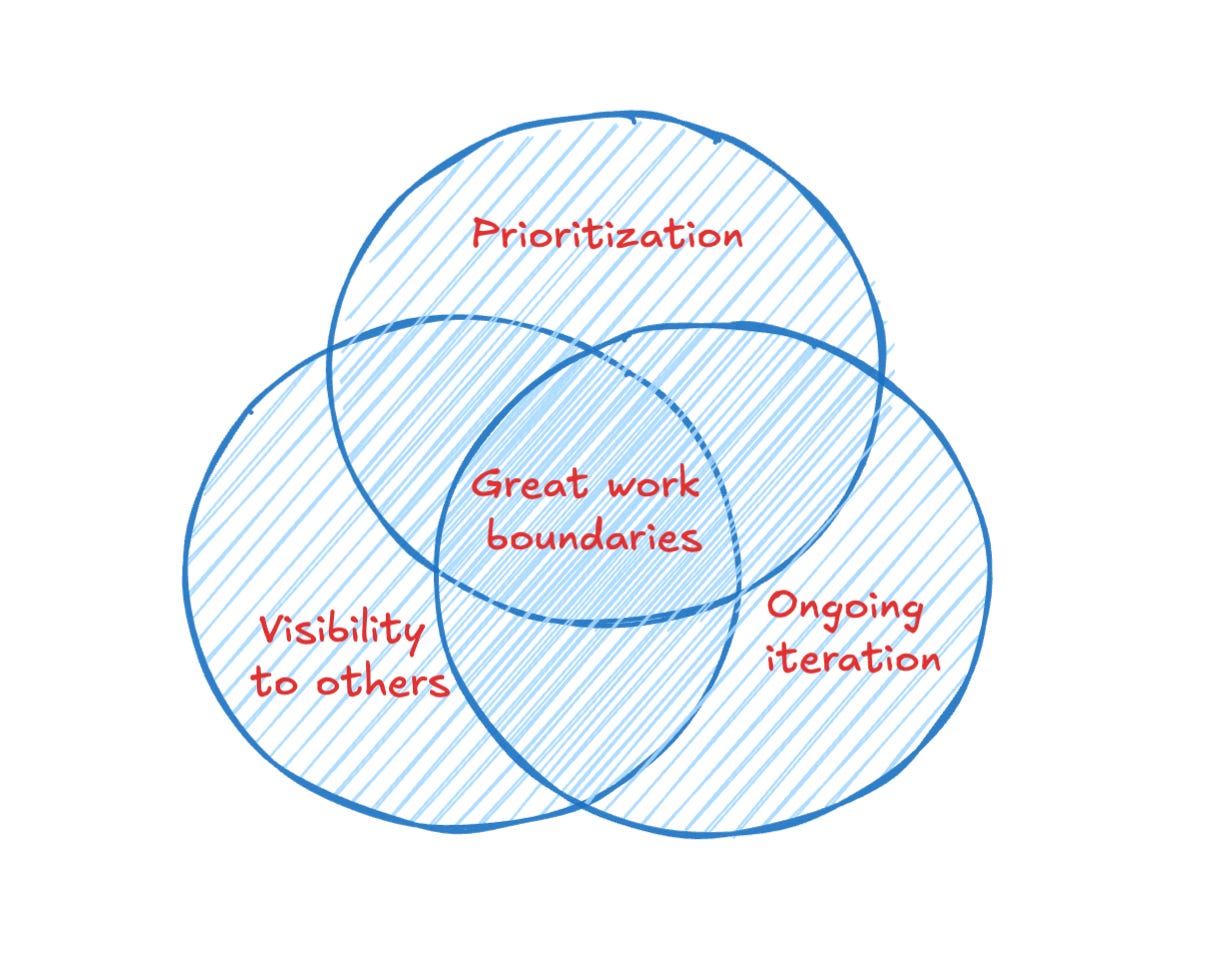
Once we’ve made the mindset shift, the next step is to set up a rhythm that allows you to create, set, and maintain great boundaries at work.
Here are the three broad steps.
Create the boundaries: Active prioritization with real trade-offs
Writing down the work we have on our plate and prioritizing it is how we figure out where the boundaries are and how to articulate them. The boundary is not “I cannot do X.” It is “I can do X, if we can drop Y.”
Take all your to-dos, make a list, and then stack-rank them by highest ROI (highest business impact for lowest effort). Draw a line for where you hit 80% capacity. For the items above the line, articulate what the benefit is. For items below the line, articulate what the impact of not doing it is, and who needs to know about it. Now that you have a clear idea of your perspective, the next step is to iterate on it with others.
Set the boundaries: Visibility to others
Once you have a priority list, share it with your manager and other key leaders who have a vested interest in your work. Make it a discussion with room for negotiation and feedback. The goal of these conversations is to look for unknowns that might affect the impact or effort of a priority, and collectively agree on which trade-offs to take. Here is where items can turn out to be lower priority than you thought, belong to someone else, could wait, or are no longer relevant. The best trade-offs are not made in a black box. They are made through conversation and in relation to others who are affected by your work. The outcome is a set of priorities that everyone is aligned on, and these are now your boundaries to protect.
Maintain the boundaries: Ongoing planned iteration
Setting boundaries is not a one and done activity. It requires ongoing revision as business and team priorities change. The markets shift, new leaders join, projects gain momentum or get deprioritized. At a startup, shifts might happen weekly. At a larger company, perhaps monthly. Therefore, setting boundaries is an ongoing exercise that follows the changes in business and people.
It’s helpful to set up a regular cadence with your manager and project stakeholders to sync on the latest context, reprioritize, and realign. It’s helpful to set up recurring forums in advance for prioritization such that this conversation comes to you. Not unlike how engineering teams work in sprints with weekly grooming sessions and open visibility through JIRA, your priorities and boundaries require similar ongoing maintenance. Don’t wait for it to be reactive (e.g. Oh I need to tell this person that their project is no longer a priority this week) because it is often less well received by others.
Boundary Setting is the Job
A core part of the job for managers and leaders is setting and maintaining boundaries for themselves and for their teams. A founder or executive who fails to set boundaries for themselves will also fail to help their team set boundaries and to make difficult trade-offs for the business. And the opposite also holds. When leaders are good at setting boundaries for themselves, they set great examples for their teams to follow.
That’s all folks! See you next week at 3:14 pm.
Yue