

Client: We’re going into Annual planning right now. We’ve done the executive-level guidance and company-level goals, and now we need to get into the details with functional and team planning. However, we’re not set up properly to plan (or execute) on some of the new areas. The teams still have ongoing work they need to deliver through Q4. How do we look forward and plan for the new work while not losing momentum on the existing priorities?
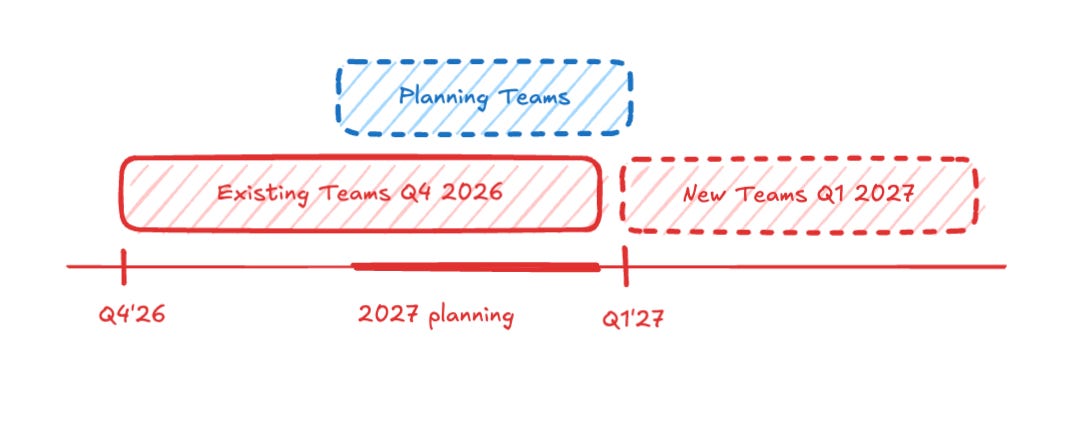
This is a classic chicken-and-egg problem that executives often grapple with when it comes to running planning cycles that run on top of day-to-day work for companies that are growing and innovating. How do I keep the current work going, yet plan for the next steps, which may not be closely related to the current work, with the same group of people?
Let’s say I run a simple product organization with 3 online retail businesses in the US: Dogs, Cats, and Other Pets. If I keep the existing teams and ask the team to plan bottom-up, then I’ll get plans that mirror the current distribution of projects. But perhaps I want to invest more in Capybaras and Goats next year, and need less planning from the Dogs and Cats team. Or, the future direction might require input from someone on another team who has a different skill set (e.g. mobile and web teams need to work together with the creative team to design in-store digital experiences for new physical stores). Or it could be such a new topic that the current team doesn’t have enough context to plan well for it (e.g. you want to enter a non-US market).
If I try to shuffle the teams first based on high-level strategic direction, then everyone gets pulled into a different set of contexts and problems, and the current work gets disrupted. In addition, I will likely make the wrong calls on how the future team should look, because there are no official execution-level plans yet. This means there will likely be another reorg after the detailed planning, and more churn for weeks on the teams.
When a company is 1) mature enough to have standing areas of investment and 2) has enough teams to cover the whole surface area of the product, then this dilemma comes up less frequently. Teams can generally plan for similar areas and scope year over year, and the small adjustments are easier to make.
However, at fast-paced, rapidly scaling startups, this issue comes up almost every quarter. Teams don’t cover the full surface area of the product, so it’s necessary to shift the same team from one area to another. If the business is also changing, then there is always a new bet to scope, or an investment that didn’t work out to defund. Changing official org lines at the strategic direction level within detailed resource plans can cause resourcing to not actually follow stated priorities, or follow-up reorgs after the plans are finalized.
The Magic of Planning Teams
To solve this dilemma, I frequently rely on a concept called planning teams. I iterated on this concept at Thumbtack and Meta, and successfully introduced it to Fuzzy Pet Health’s team of ~150 across engineering, PM, and design as we quickly iterated through multiple different strategies over 2 years.
Planning teams are temporary teams assembled for planning purposes. A planning team is formed for each important area of investment for the next year. Each team has a planning lead and includes critical members from each function that needs to be involved in the planning (e.g., marketing, sales, customer support, operations, finance, engineering, design). This team meets according to the planning cycle, coming together for brainstorming sessions, prioritization, resource planning, and executive reviews.
The planning team model solves for a few important challenges:
A scarce resource could help on multiple planning teams. Let’s say you have one AEO expert, yet two areas require AEO support. That person could join both planning teams, even if they will not officially work on one of the areas.
Existing work and team cadences can continue in parallel to the planning team work. Planning teams are not official teams with reporting lines or component ownership. They remain lightweight and distinct from performance management cycles.
Planning teams do not have to have continuity beyond the planning period (though some may). This gives executives a chance to rebalance resources after the detailed planning is complete without touching official org lines.
There can be more people on the planning team and in the planning discussions than in day-to-day team execution. The planning team allows for more cross-functional input early on, without slowing the core execution team down later.
It allows executives to see how someone performs in a new area or extended scope in the planning process before formalizing new leadership roles. It also gives executives a chance to see the dynamics of a team for a few weeks before formalizing the new team structures.
Planning teams often do become official teams after some adjustment, particularly for brand new areas of investment. Therefore, as a leader, it is important to choose the teams with some care and thought. It sets up future leaders to lead and is often the beginning of new group dynamics. However, without the additional stress of official org line changes, planning teams can remain flexible and shift based on where business cases and priorities fall after detailed planning.
That’s all folks! See you next week at 3:14 pm.
Yue