

Yue’s Coaching Corner
I recently sat down with Hilary Gridley to discuss the new Super IC path to leadership and whether it’s a YAY or NAY. Watch the recording here.
Outsmart the Room: AI-Powered Executive Communication & Influence is now enrolling for June. Get heard and get promoted with AI as your secret weapon.
Get $150 off with SPRING150! First 10 clients only.
Want to become irreplaceable in the age of AI? Accelerate your path to leadership? Consider working with me 1:1. Schedule a free intro call here.
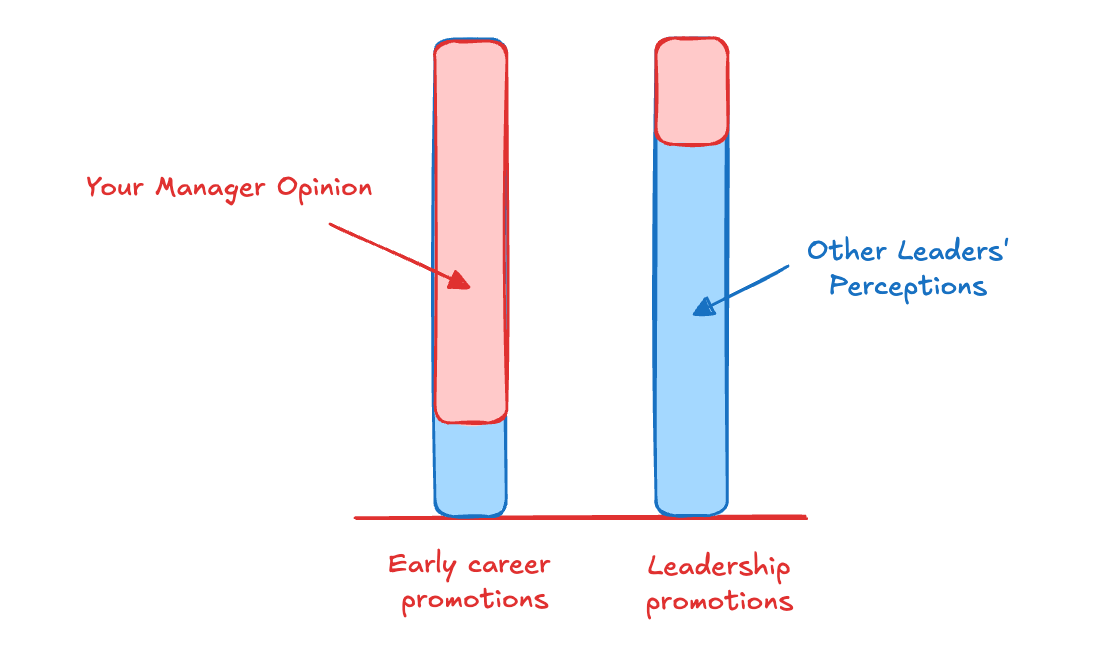
As you progress in your career, how your peers view your performance takes on increasing weight relative to what your manager (or even sometimes skip level) thinks. Your manager’s view of your performance is critical, but insufficient at senior levels in securing a specific rating. What becomes more important is that your performance is well understood by all the broader organization and teams you don’t regularly collaborate with, especially those who might hold outsized influence in the business.
Calibrations: where “informal feedback” influences the outcome
Formal reviews generally include feedback from your team, your peers, and your managers. However, once you get into the promotion conversations, the people who may comment on your performance are far more wide-reaching.
At bigger companies, the exposure happens during “calibration sessions”, where managers meet to ensure that the reviews are “calibrated” across teams and functions, so the same bar is held by function and seniority. This process tries to avoid the bias that a person doing well on one team could just be average in another, resulting in unfair promotions specific to certain teams. It also ensures that managers don’t miss any feedback from other teams. Calibration sessions open up your performance for discussion and comparison across tens to hundreds of people. At this point, it is no longer just about the people you interact with regularly; it becomes about your brand and reputation.
Many small or early-stage companies don’t have official performance reviews. However, even though your company claims they do not have performance reviews, they still review performance. At smaller companies, reputation is even more critical as there are more casual conversations for senior leader performance, and it can be very “obvious” who holds the influence in a smaller team.
Common surprises during calibrations
People who believe they are ready for promotion and have heard similarly from their manager can be unpleasantly surprised when the official performance review is delivered. The conversation sounds like this:
VP: Hey everyone, I’m Jane’s manager. Jane’s been doing a great job and has been performing at the VP level for more than a year. She successfully launched a multi-team, multi-quarter project and has shown that she can handle more scope. Jane has been delivering a great consistently, and I would like to put her up for promotion to VP.
Peer VP: Jane took an original idea from my PM director, Joe. Joe was working on the project, but she stepped in midway and ran with it. They collaborated on the project, but she ended up in multiple conflicts with Joe. I don’t think she handled the collaboration well or deserves full credit.
SVP 2: My PM director is managing multiple cross-team projects and has consistently delivered double-digit increases in revenue. He has not yet been promoted. Perhaps we should consider him first?
Peer VP 3: When I look at this project and the measured impact, was it calculated correctly and over the right time horizon? Didn’t this other initiative help inflate the numbers?
In this case, Jane’s promotion was blocked due to objections she’d never heard and that may or may not be fully accurate. Sometimes, promotion conversations can take unexpected dives for the worse simply based on the room dynamics at the time. At the core of it, this happens for a few reasons:
There are unexpected vocal detractors in the room
The overall team is underperforming
The manager is viewed as too subjective or not confident enough in their evaluation
One small comment of hesitation from someone with a large amount of influence in the room
To combat this, it’s important to find advocates and ensure critical decision-makers are on board ahead of formal performance conversations.
How to manage your performance review
Like product reviews or business reviews, performance conversations require influence strategies and pre-meetings.
First, keep an ear to the ground to gather information about how your team and organization are doing. Make sure when you talk about your wins that others are buying into the narrative.
Then, a few months from promotion time, you and your manager should talk to other leaders and teammates in the organization to proactively ask for feedback. This way, you’ll know who will or will not advocate for you, avoiding surprises during promotion time. Knowing whom you must win over early gives you time to invest in building trust and strengthening relationships.
Finally, enlist other advocates for your promotion. Because your manager is your manager, she may be perceived as biased in presenting the case for promotion. You and your manager should try to find another influential advocate who will be in the room. Ask that person to mentor you and help them get to know you over time. Then, during promotion conversations, another person in the room can speak to your capabilities more objectively.
Did you receive your performance review back recently? How did it go? Was it as expected?
That’s all folks! See you next week at 3:14 pm.
Yue
The shift from a manager’s opinion to a broader leadership narrative is where many high performers get caught. They keep managing the review, while the organization is already evaluating enterprise impact, peer confidence, and whether others would choose to work alongside them at the next level.
The criteria changed; the feedback system usually did not.
Thanks for this piece! Makes total sense that as you rise the ranks, the feedback of other teams outside your immediate chain of command becomes increasingly important.
While I don’t ask for feedback from other teams formally, I’ve found that taking ownership in cross functional settings where there is “messy” work to be done, and treating others (and their calendars!) with the utmost respect regardless of title has done a lot for my career.