

Marcus had been a Senior Manager for three years. He was convinced he was operating at a Director level, and yet, he was consistently passed over for promotion. In our second coaching session together, I laid it out directly: Marcus, you’re not being passed over because you’re not smart or good enough. You’re being passed over because your organization sees you as a strong Senior Engineer, not a leader.
The Signals That Hold You Back
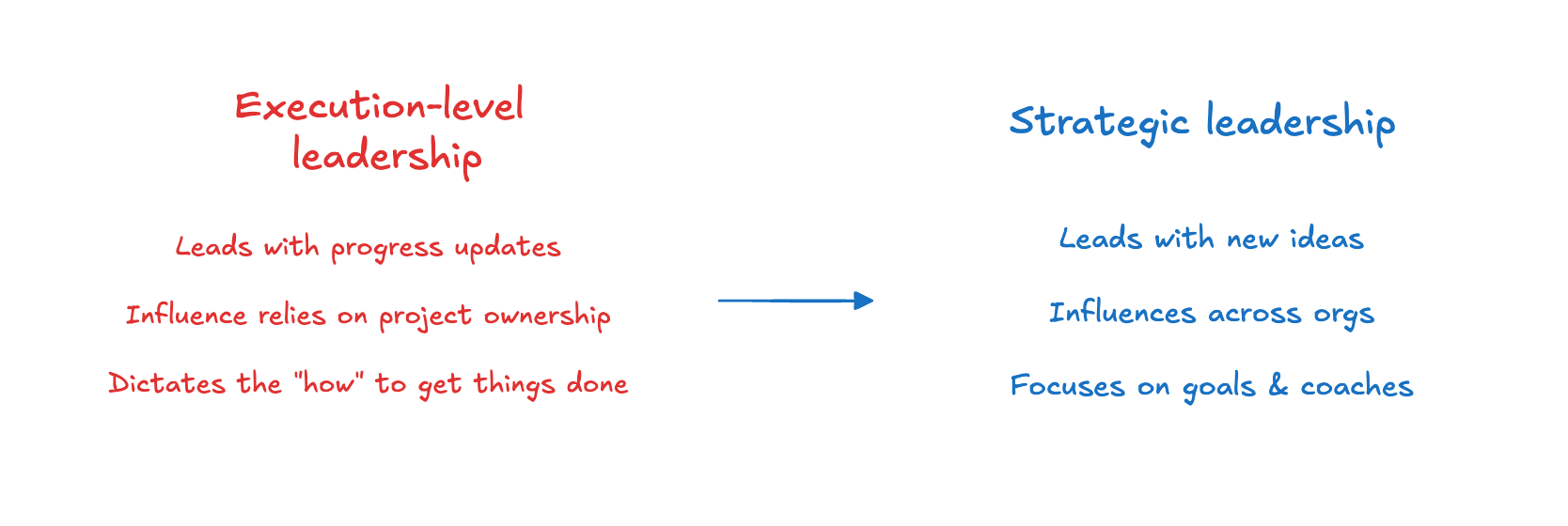
As much as you think you are ready for that next level, certain behaviors and actions signal to leadership that you are mostly executing, not leading. This can get frustrating because noone really clarifies the difference.
Here are four that I come across frequently:
1. Your “Strategy” Is Really Just Prioritization
Some leaders call it strategy when they rank tasks, sequence projects, and make trade-offs within their team. While it is a form of strategy, it is not a leadership-level strategy. It feels more like organizing a box.
Leadership-level strategy is about framing and making tradeoffs that impact multiple teams and functions. The impact magnitude can be measured with company-level metrics, and execution time is on the time horizon of quarters and years.
It’s not what your team (or close partner teams) work on in the next few weeks. Real strategic work pulls you out of your domain.
2. Your Influence Stops at Your Job Description
Many people think they have leadership-level influence when they are only playing in their lane. Their influence mostly comes from being responsible for a particular project or task. People listen to you about your team’s work because you’re the person accountable for it. This is only table stakes.
True leadership level influence is when people seek out your perspective on things that aren’t in your domain. When you’re invited into conversations because of what you think, not what you own.
Directors and VPs who are genuinely operating at a leadership level spend a meaningful portion of their time helping others outside their teams. They’re shaping conversations about areas they don’t formally own.
If your influence lives mostly “within my team’s scope,” you’re not there yet.
3. You Start With Execution Updates
Think about your last few 1:1s with your manager or skip-level. What did you lead with? If the answer is “what shipped, what’s in progress, and where things stand”, then you are leading with execution.
A leader leads with strategy and ideas:
Here’s an idea I’ve been thinking about for how we could address this market differently
I’ve noticed this unhealthy pattern across three teams that I think we need to fix.
I want to talk through how we can grow our team’s scope next year.
Execution updates can usually be written and read. When it comes to airtime with leadership, lead with perspectives, ideas, and problems to solve.
4. You’re Still the Answer
As a high performer, you may pride yourself on being the person who solves problems. When the team comes to you with a question, you dive in, triage, and give answers.
Leaders don’t default to solving a problem themselves. They ask questions that help their team find the answer. Or they let problems simmer…so that someone on the team can rise to solve it. They don’t step in unless absolutely necessary.
Many managers know this intellectually. But it’s hard because when you’re watching something go sideways and you have the answer in your head, sitting on your hands feels irresponsible.
As a leader, your job is no longer to have the answer. Your job is to build the rooms where the answer can emerge. This is why leaders spend time on forums, processes, and people.
What Marcus Did
Six months after that conversation, Marcus was promoted to Director.
He didn’t work harder. He stopped solving his team’s problems and started asking questions to help them find the answers. This freed up time for him to meet with leaders outside his org to hear their problems. He stopped opening his 1:1s with a rundown of the sprint and started with problems and ideas he was thinking through. This generated introductions to other senior leaders and airtime during the monthly all-hands.
If you feel stuck at your level, take a look at your strategy, influence, and execution patterns. Are you going broad enough? Do you influence beyond your scope? Are you still giving out answers?
That’s all folks! See you next week at 3:14 pm.
Yue
Yue’s Coaching Corner
Join the next cohort of my live course, Master Executive Presence & Communication with AI (4.5/5, top 100 maven)! We start mid-May. The 3 week course is filled with live workshops, AI usage tips, and frameworks for those who want to level up their communication and influence. Learn more here.
The April cohort of Yue’s AI Amplified Leadership Accelerator is wait-list only now. I’m super excited for a new format with more live interactions, live coaching, and a focus on soft skills that are critical in the age of AI. Now enrolling for the next cohort in June!
Interested in 1:1 Leadership Coaching with me? Booking clients for a Mid-May start. Learn more via a free intro call here.
Totally agree with your perspective on strategic leadership - I just wrote an article on this too! Would love if you’d follow my writing on leadership (especially for women in tech). https://theleadwellcollective.substack.com/p/the-invisible-leader?r=850skx&utm_medium=ios
https://ianmcniff.substack.com/p/the-dogma-code-and-the-rationing?utm_source=share&utm_medium=android&r=2lo6de